News
Selank|CAS:129954-34-3
Taking 129954-34-3 as an example, let's see how a heptapeptide can be "measured clearly"
A CAS number is just a string of numbers for most people; For someone who makes peptides, it points to a specific molecule.
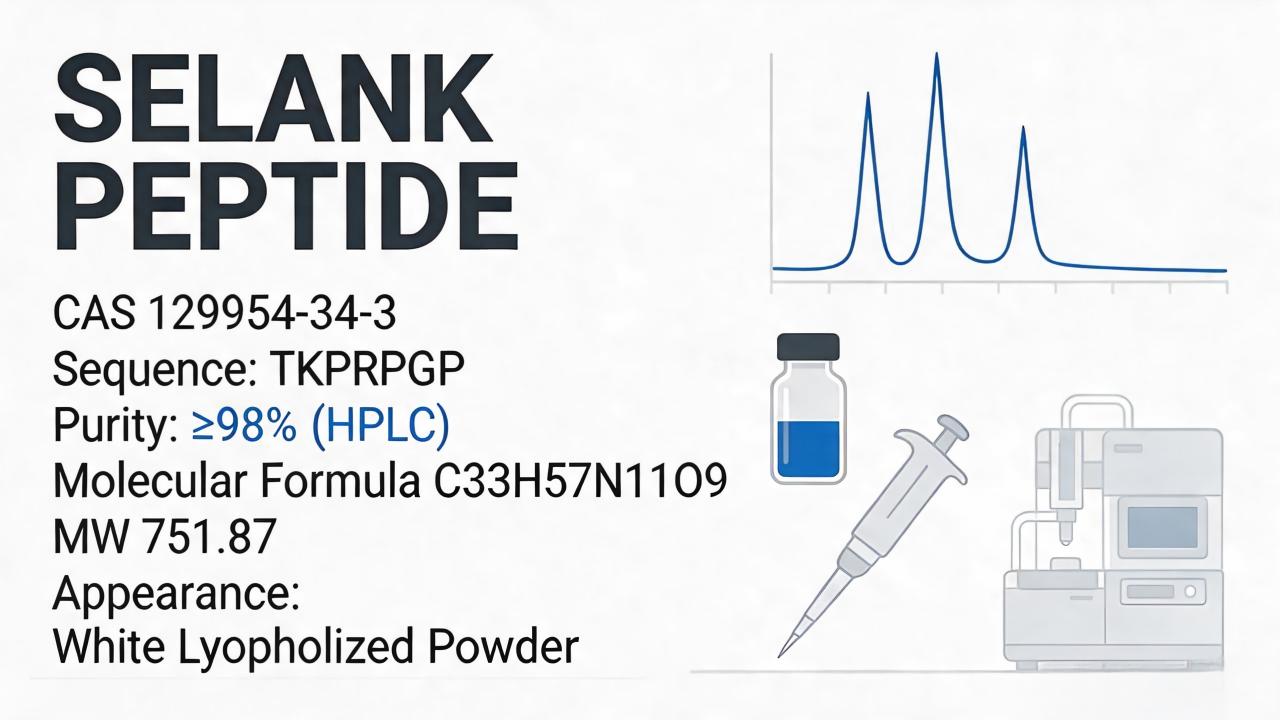
129954-34-3 corresponds to a synthetic heptapeptide consisting of seven amino acids, with the sequence Thr Lys Pro Arg Pro Gly Pro, molecular weight 751.87, structurally modified from the natural immune regulatory peptide Tuftsin. In recent years, such research peptides have been frequently used in the field of neuroscience.
Why are these types of samples difficult to test?
Peptides are located in the "middle zone" between small molecules and proteins: more complex than small molecules and more delicate than proteins. Adding one more amino acid or missing one chiral center may significantly alter the physicochemical properties; A small shoulder peak on the purity spectrum may be behind a missing peptide, racemate, or oxidized product. Whether a peptide is "it" or not requires evidence at the sequence level, not just whether the retention time matches.
So, peptide testing has never been about "running a needle and producing a report".
At the NTS laboratory in Hong Kong, we only do one thing - accurately and clearly measure peptides.
We have built a complete detection method system around peptides, covering dimensions such as identification, purity and impurity spectrum, content, structure confirmation, and stability. The method does not blindly follow the general plan: each item has undergone method development and validation, with clear scope of application, detection capability, and data reliability, and every number in the report can be returned to the original record.
More importantly, we are willing to open up the process.
The entire testing process is observable and can be questioned: customers can understand how the samples are received, how they are pre processed, and what key nodes are judged based on; We also welcome customers to make appointments to visit the laboratory - to see the instruments, sample circulation, and original records, turning "can you do it" into "I can see with my own eyes how you do it".
Supported by this system is a team primarily composed of doctoral students and professors.
Some of them have been engaged in peptide synthesis and purification for a long time, while others focus on separation and mass spectrometry analysis. When encountering difficult samples outside of conventional methods such as degradation, isomerization, and lack of reference standards, we can provide methodological judgments at the molecular level rather than simply saying 'we cannot do it'. Bringing scientific research ideas into testing is the biggest difference between us and ordinary testing institutions.
If you also have a peptide sample that is difficult to describe or measure, please feel free to send us the information first.