News
PT-141|CAS:189691-06-3
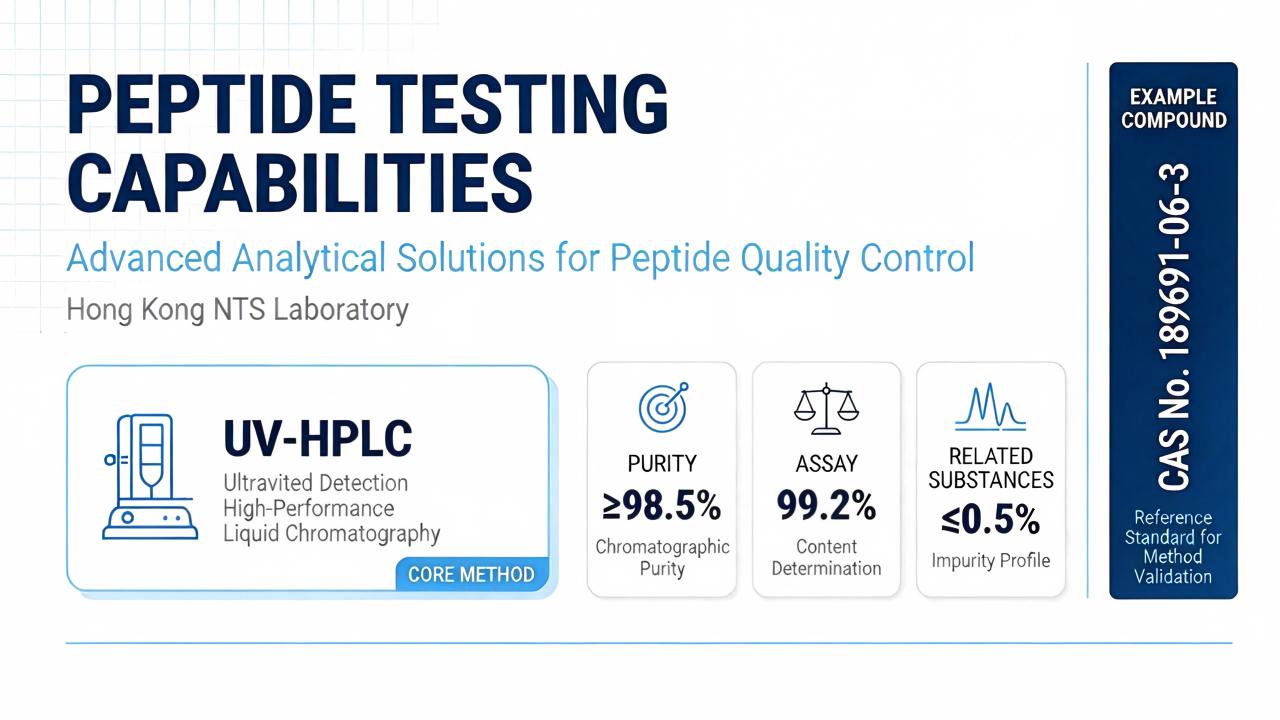
Taking 189691-06-3 as an example: The peptide detection capability, UV-HPLC method, and expert team of NTS laboratory
Taking the cyclic peptide Bremerhand with CAS number 189691-06-3 as an example, the NTS laboratory uses ultraviolet detection high-performance liquid chromatography (UV-HPLC) as the core method, which has the ability to detect peptides covering purity, content, and related substances. The detection conditions are optimized for each variety, and the laboratory can be visited by appointment. The original spectrum can be traced throughout the process.
1、 Molecules that are significantly different from conventional linear peptides
The molecular formula of this variety is C50H68N14O10, with a molecular weight of approximately 1025.2 Da. The single letter sequence is written as Ac-Nle-cyclo [Asp-His-D-Phe-Arg-Trp-Lys] - OH, and four modifications are present simultaneously: N-terminal acetylation, leucine substitution, D-type phenylalanine, and side chain amide cyclization.
Difficulties also arise. N-terminal acetylation and cyclization result in a lack of ionizable free α - amino groups in the molecule, and the peak shape is prone to tailing in conventional mobile phases; The conformational changes caused by D-Phe result in the formation of isomeric impurities with retention times close to the height of the main peak; Tryptophan residues are sensitive to light and oxygen, and oxidized impurities often appear adjacent to the main peak; Missing peptides, truncated peptides, and incomplete deprotection sequences have similar hydrophobicity and are easily squeezed into the same elution window. Insufficient separation renders purity data meaningless.
2、 UV-HPLC: The main platform for purity, content, and related substances
The main detection platform of NTS laboratory is UV-HPLC, equipped with a UV variable wavelength detector, using 214 nm as the measurement wavelength for peptide bond characteristic absorption; Set up a 280 nm reference channel for varieties containing tryptophan and tyrosine to assist in determining the main peak attribution and impurity source.
The chromatographic conditions are designed around molecular properties: a C18 reverse phase column is used with a pore size adapted to the peptide, and the mobile phase is a gradient elution of 0.1% trifluoroacetic acid aqueous solution and acetonitrile. The gradient slope, column temperature, and flow rate are optimized for each species to ensure baseline separation of the main peak and adjacent impurity peaks. The purity is calculated using the area normalization method, and the content is quantified using the reference standard external standard method if necessary; Verify the applicability, specificity, precision, linearity, detection and quantification limits of the system item by item according to the specifications. Different salt types and residual solvents are separately controlled in separate projects.
3、 Structural confirmation and orthogonal verification of chirality
Chromatography provides separation and content, and structural issues require orthogonal methods to answer. The laboratory verifies the molecular weight of the main components, and controls the deviation between the measured values and the theoretical values at the ppm level; Collect peptide fingerprints using specific enzymatic hydrolysis combined with mass spectrometry, and compare sequence coverage, lactam cyclization sites, and N-terminal acetylation one by one to see if they are consistent with the target structure; Measure the ratio of D - and L-type amino acids separately to evaluate the degree of isomerization. Multiple sets of data support each other, and the differences on the spectrum can be explained, not just by a percentage.
4、 A laboratory that can be walked in
NTS laboratory implements zoning and temperature and humidity control management. Customers are welcome to make appointments for visits. The tour route covers various stages from sample reception and registration, pre-processing and weighing, precision instrument analysis, to data processing and report issuance. The instrument status, standard traceability information, original spectra, and methodological validation records can all be accessed on-site, and the testing process can be traced and reviewed.
5、 Expert team led by doctors and professors
The core team is composed of PhDs and university professors, with research backgrounds covering analytical chemistry, pharmaceutical analysis, and peptide chemistry. The development of methods, validation of methodologies, and problem localization of difficult samples are reviewed by senior researchers; Faced with varieties with unique structures and complex impurity spectra, the team provided an interpretation based on orthogonal data and literature evidence. Specific varieties can be reserved for consultation and visits.